
Chhath Puja 2025: The Festival of Sun, Faith, and Togetherness
- September 3, 2025
- Uncategorized
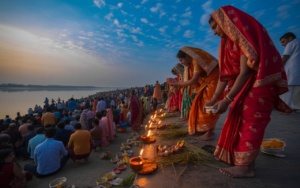
Introduction: A Festival Straight from the Heart
India is known for its colorful festivals, and while Diwali and Holi often steal the spotlight, there are many other celebrations that touch the heart in a deeper way. Chhath Puja is one such festival. It is not about lights or colors but about devotion, discipline, and gratitude to the Sun God. Celebrated mostly in Bihar, Uttar Pradesh, Jharkhand, and Nepal, Chhath Puja is now spreading across India because people carry this tradition wherever they go.
What makes Chhath Puja unique is its simplicity. There are no idols, no grand decorations, no temples filled with crowds. Instead, people gather near rivers, ponds, or lakes and pray to the setting and rising sun. It is a festival that connects humans directly with nature.
Why Chhath Puja is Special
Unlike other festivals, Chhath Puja is:
Dedicated to the Sun God (Surya Dev), who is considered the giver of life and energy.
Focused on purity and discipline—devotees follow strict fasting and rituals for four days.
Environment-friendly, as most rituals happen in open nature near water bodies.
A community celebration, where neighbors, relatives, and even strangers help each other.
For many families, Chhath Puja is more than tradition—it is a way of life.
The Story Behind Chhath Puja
Every festival in India has a story, and so does Chhath Puja. According to Hindu mythology:
It is believed that Karna, the son of the Sun God and a great warrior from the Mahabharata, was the first to worship the Sun using Chhath rituals.
Another story says that Draupadi and the Pandavas also performed Chhath Puja during their exile to seek blessings and overcome troubles.
Spiritually, it is said that worshipping the Sun God during this time helps cleanse the mind and body, bringing health, prosperity, and happiness.
The Four Days of Chhath Puja
Chhath Puja is not a one-day event. It lasts four days, and each day has its own importance:
1. Nahay Khay (First Day)
Devotees take a holy dip in the river and bring water home.
The house is cleaned, and only satvik (pure vegetarian) food is prepared.
The fasting begins with this ritual.
2. Kharna (Second Day)
On this day, devotees fast from morning till evening without water.
After sunset, they break the fast with kheer (made of jaggery, rice, and milk) and chapati.
After this meal, a 36-hour fast without food and water begins.
3. Sandhya Arghya (Third Day)
The most important day.
Devotees and families gather near rivers, lakes, or ponds in the evening.
They offer arghya (prayers with milk, water, sugarcane, fruits, and thekua – a traditional sweet) to the setting sun.
The sight of thousands standing in rivers with baskets of offerings is truly magical.
4. Usha Arghya (Fourth Day)
The final day of Chhath.
Devotees gather again at the riverbanks before sunrise.
They offer prayers to the rising sun, asking for blessings of health, prosperity, and happiness for their family.
The 36-hour fast ends after this ritual.
The Role of Women in Chhath Puja
Though men also participate, women play a central role in Chhath Puja. Known as Vrati (those who keep the fast), they show immense strength and discipline by staying without food and water for 36 hours. Many women say they do this out of love and prayers for the well-being of their families.
In villages and cities alike, the sight of mothers, daughters, and grandmothers singing traditional Chhath songs is heartwarming. These songs are not just music—they are blessings passed from one generation to another.
The Event Management Side of Chhath Puja
Now, you may wonder—what does event management have to do with a religious festival like Chhath Puja? The truth is, in today’s time, Chhath Puja has become a mega community event that requires proper planning and management.
Here’s how:
1.Preparation of Riverbanks
Thousands of devotees gather at ghats (riverbanks). Event organizers and local authorities prepare the area, clean it, and make it safe.
Temporary stages, bamboo structures, and lighting are installed.
2.Safety Arrangements
Because crowds are huge, event managers plan for security, first-aid, and crowd control.
Lifeguards and divers are often stationed at ghats for emergencies.
3.Logistics & Facilities
Drinking water, toilets, resting areas, and parking facilities are arranged.
Volunteers are placed to help elderly devotees.
4.Cultural Programs
In cities, small cultural events and music programs are organized alongside Chhath to keep the community engaged.
5.Eco-Friendly Focus
With awareness growing, organizers promote eco-friendly offerings and discourage plastic use.
In short, Chhath Puja is not just a religious event—it is a large-scale community event that shows how traditional festivals and modern event management work hand in hand.
The Experience of Chhath Puja: What Makes it Different?
If you’ve ever been to a Chhath Puja ghat in Patna, Varanasi, or Delhi, you’ll know the atmosphere is something else.
The sound of folk songs, sung in Maithili and Bhojpuri.
The smell of fresh thekua and sugarcane juice.
The sight of thousands of diyas (lamps) floating in rivers at night.
The silence of devotees standing waist-deep in water, praying with folded hands.
It feels less like a festival and more like a deep spiritual journey shared with millions.
Chhath Puja Across India and Abroad
While Bihar and UP are the heartlands of Chhath Puja, the festival is now celebrated widely:
Delhi NCR: Yamuna ghats witness lakhs of devotees.
Mumbai: Beaches like Juhu become centers of celebration.
Kolkata: Hugli riverbanks shine with lights and offerings.
Abroad: Indian communities in USA, UK, UAE, Mauritius, and Nepal also celebrate Chhath with the same devotion.
No matter where it is celebrated, the emotions remain the same.
The Modern Touch to Chhath Puja
In today’s digital world, Chhath Puja is also going online. Live telecasts, YouTube streams, and social media bring the celebration closer to those who can’t attend physically. Event organizers also use drones, LED lights, and eco-friendly decorations to make the event more attractive and safe.
Conclusion: Chhath Puja as a Lesson in Faith and Unity
Chhath Puja is not just another Indian festival—it is a festival of discipline, simplicity, and deep devotion. It teaches us that celebrations don’t always need money, grandeur, or luxury. Sometimes, the purest celebrations are those where people stand together, pray together, and thank nature for life itself.
For event managers, Chhath Puja is an example of how even the most traditional events need planning, organizing, and creativity. From arranging ghats to managing lakhs of people, it shows the true power of teamwork and community spirit.
- At the end of the day, Chhath Puja reminds us of one thing:
Faith, family, and togetherness are the biggest celebrations of life.
Subscribe to our newsletter!
More from our blog
See all posts



Recent Posts
- Makar Sankranti: A Perfect Festival for Events January 9, 2026
- Every Event Has a Silent Star October 7, 2025
- Surprise Celebrity Visits In India : How Stars Bring Joy and Excitement. September 10, 2025