
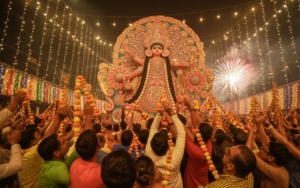
Durga Puja is not just a festival—it’s an emotion. Every year, as the autumn breeze fills the air in Kolkata, the city transforms into a grand stage. Streets glow with lights, giant pandals (temporary decorative structures) rise like palaces, and millions of people step out to celebrate the arrival of Goddess Durga. For five days, the city doesn’t sleep—it sings, dances, eats, and prays together.
Durga Puja in Kolkata is more than a religious ritual. It’s an art exhibition, a carnival, a cultural program, and one of the largest public events in the world. In fact, UNESCO has even recognized Kolkata’s Durga Puja as an Intangible Cultural Heritage of Humanity.
But what makes this festival so unique? And how does event management play such a big role in making it successful? Let’s dive in.
The Story Behind Durga Puja
The festival celebrates the victory of Goddess Durga over the demon Mahishasura, symbolizing the triumph of good over evil. Traditionally, idols of Goddess Durga are made of clay and beautifully decorated with colors, ornaments, and sarees. Alongside Durga, idols of her children—Lakshmi, Saraswati, Kartikeya, and Ganesha—are also worshipped.
In Kolkata, Durga Puja is not just about worship—it’s about celebration, art, and community spirit.
The Preparation Begins Months Before
Durga Puja is not a festival that begins in October. For organizers, artists, and event managers, the work starts almost a year in advance.
Idol Making in Kumartuli: Kumartuli, a famous potters’ area in North Kolkata, comes alive with artists crafting idols from clay. Watching them bring the Goddess to life is magical.
Theme Planning for Pandals: Each puja committee decides on a theme—some are traditional, while others are modern and experimental. Pandals are designed like temples, palaces, caves, or even world monuments.
Sponsorship & Budgeting: Some of the top pujas have budgets in crores, with sponsors ranging from corporate houses to local businesses. Event managers play a big role in balancing costs and creativity.
Pandals: The Showstoppers of Kolkata
If you ask anyone what makes Kolkata’s Durga Puja special, the answer will be “pandals.”
Traditional Pandals: Some pujas, like Bagbazar or College Square, keep it traditional with age-old styles.
Theme Pandals: On the other hand, famous pujas like Ekdalia Evergreen, Sreebhumi Sporting Club, or Santosh Mitra Square go for jaw-dropping themes. Imagine walking into a pandal shaped like the Vatican, a Rajasthani palace, or even Hogwarts—it’s all possible in Kolkata.
Lighting of Chandannagar: The light decorations, especially from Chandannagar artisans, turn streets into glowing galleries.
Event management here is like managing multiple “mini-events” within one giant festival. Each pandal is an event in itself with planning, crowd control, decoration, and security.
The Five Days of Durga Puja
Durga Puja officially lasts for five days—Shashthi, Saptami, Ashtami, Navami, and Dashami.
Shashthi – The unveiling of the Goddess. Crowds rush to pandals to see the idols for the first time.
Saptami – A banana plant, symbolizing the Goddess, is bathed in the river and placed beside the idol.
Ashtami – The biggest day of worship, with the famous Pushpanjali (flower offering) and Sandhi Puja at midnight.
Navami – Cultural programs, dances, and dhunuchi naach (dance with incense) light up the night.
Dashami – The emotional farewell as idols are taken for visarjan (immersion) in the river, and people share sindoor khela (married women apply vermillion on each other).
For event managers, each day brings new challenges—managing thousands of visitors, arranging sound systems, handling cultural programs, ensuring security, and keeping everything on schedule.
Food: The Flavor of Festivity
No Durga Puja is complete without food. Streets are filled with stalls selling rolls, biryani, phuchka (pani puri), sweets like rasgulla, and more. Restaurants offer special “pujo menus.”
Event management teams often collaborate with food vendors to organize food festivals inside pandals, ensuring hygiene, crowd control, and smooth service.
Cultural Programs: The Soul of the Festival
Durga Puja is not only about pandals and food—it’s also about cultural expression. Every evening, stages are filled with dance, music, plays, and fashion shows. Local artists, schools, and even celebrities perform during the festival.
Here, event managers handle:
Scheduling performances
Stage setup and lighting
Sound management
Audience seating and safety
It’s almost like organizing hundreds of mini-concerts across the city at the same time.
Crowd Management: The Biggest Challenge
Durga Puja in Kolkata attracts millions of visitors. Managing these crowds is a Herculean task.
Event management teams and police work together on:
Entry & Exit Routes: Clear paths to avoid stampedes.
Queue Systems: Barricades and volunteers to maintain order.
Emergency Services: Ambulances and medical booths ready for any mishap.
Technology Use: Drones, CCTV, and apps help track crowds and guide visitors.
Without this management, enjoying the festival safely would be impossible.
Sponsorships & Media
Durga Puja is also big business. Sponsorships from companies fund most pandals, and in return, brands get huge visibility. Advertisements are placed on gates, banners, and even inside pandals.
Event managers negotiate with sponsors, design ad placements, and ensure both creativity and commercial needs are met. Media coverage also plays a huge role, making pujas popular on TV and social media.
Eco-Friendly Durga Puja
With rising awareness, many puja committees are focusing on sustainable celebrations. Event managers help by:
Using eco-friendly idols (clay, natural colors).
Managing waste disposal.
Organizing green pandals using bamboo, jute, and recycled products.
Promoting awareness campaigns on pollution control.
This shift shows how events can be grand yet responsible.
Why Kolkata Durga Puja is a Lesson in Event Management
Durga Puja is not just a religious celebration—it’s one of the best examples of large-scale event management in the world. It involves:
Project Planning – from budgeting to theme selection.
Teamwork – involving artists, carpenters, electricians, sponsors, police, and volunteers.
Time Management – months of preparation for five days of perfection.
Crisis Handling – managing crowds, safety, and emergencies.
Creativity & Innovation – turning every pandal into a masterpiece.
For a fresher in event management, studying Durga Puja is like attending the biggest “live classroom” in the world.
The Emotional Farewell
On Dashami, as idols are immersed in the river and people chant “Asche Bochor Abar Hobe” (It will happen again next year), Kolkata returns to its routine. But the memories of pandal hopping, music, food, and togetherness remain forever.
For the people of Kolkata, Durga Puja is not just a festival—it’s their identity. And for event managers, it is proof that with teamwork, planning, and creativity, even the biggest dreams can come true.
Conclusion
Durga Puja in Kolkata is a festival that combines faith, art, culture, food, and event management into one unforgettable experience. From idol-making in Kumartuli to the grandeur of theme pandals, from cultural shows to food stalls, and from crowd control to eco-friendly initiatives—it is the perfect example of how events can touch millions of lives.
At Liferecall, we believe festivals like these remind us that celebrations are not about money, but about memories, unity, and joy. Kolkata Durga Puja is living proof of that.
Subscribe to our newsletter!
More from our blog
See all posts

Recent Posts
- Makar Sankranti: A Perfect Festival for Events January 9, 2026
- Every Event Has a Silent Star October 7, 2025
- Surprise Celebrity Visits In India : How Stars Bring Joy and Excitement. September 10, 2025